
New Blocks on the BMC
You’ve probably seen the Business Model Canvas (BMC) before. It’s one of those tools that actually works well in the real world, and one that we refer to on a regular basis. Recently, we found out that some organisations have been adding extra blocks to it, specifically for “eco-social costs” and “eco-social benefits.”
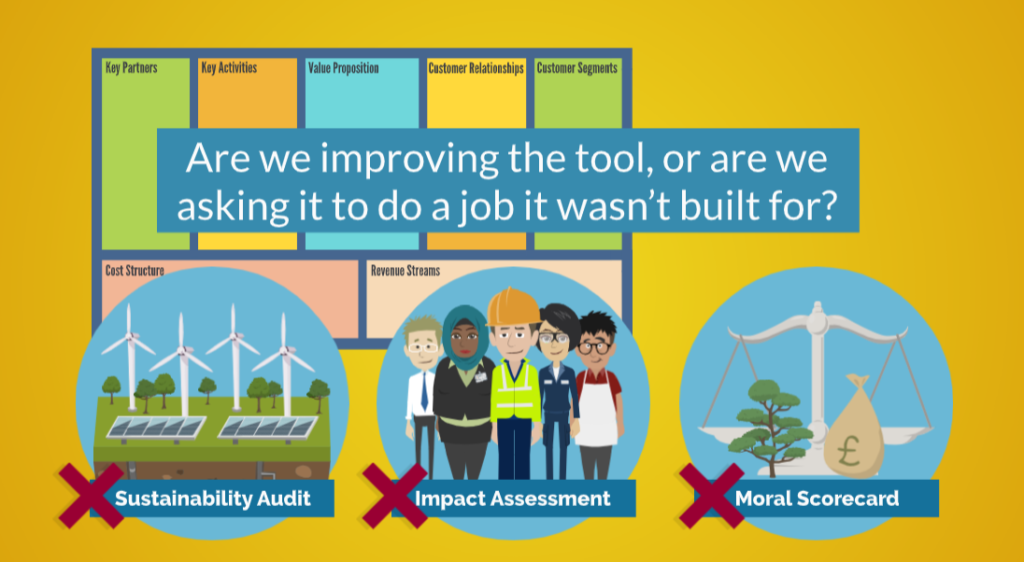
Which raises an interesting question: Are we improving the tool when we add blocks, or have we misunderstood what it’s for?
We explore this question in our latest You Tube video, which you can find here: https://youtu.be/_vm-BWA-6dE

But if you prefer to read your content, there is a summary here:
What the Business Model Canvas was designed to do
Let’s start with the basics. The Business Model Canvas was created to map how an organisation creates, delivers and captures value. That’s it. It’s effective because it’s simple. Nine blocks on one page that provide a shared language for strategy.
But the canvas wasn’t designed as a sustainability audit or impact assessment tool. When we start adding extra boxes, we need to ask: are we improving it or forcing it to do a job it wasn’t built for?
Why add sustainability blocks to the Business Model Canvas?
The motivation is sound. Businesses need to address environmental impact and social responsibility, and the original Business Model Canvas doesn’t explicitly prompt these conversations.
Adding eco-social blocks aims to make sustainability visible, which can be valuable in the right context.
When additional blocks work
Extra blocks can be useful for:
- Teaching sustainability strategy
- Running CSR-focused workshops
- Comparing business models through an environmental lens
In these contexts, additional blocks act as lenses, helping teams ask: “What harm does this model create?” and “What good does it create beyond profit?”
When additional blocks signal misunderstanding
Adding blocks can also indicate the Business Model Canvas purpose isn’t fully understood. It raises a few potential problems:
Problem 1: The canvas becomes cluttered. Every new trend shouldn’t get its own box—that destroys the tool’s clarity.
Problem 2: New blocks duplicate existing ones. Single-use plastic packaging already belongs in Key Resources. Sustainable packaging costs affect your Cost Structure. Environmental benefits appear in your Value Proposition. If sustainability isn’t showing up in the original blocks, the issue is your analysis, not the canvas.
Problem 3: It becomes a checkbox exercise. If teams fill in new boxes without integrating sustainability into their core business model, nothing changes.
The better approach to sustainability in the Business Model Canvas
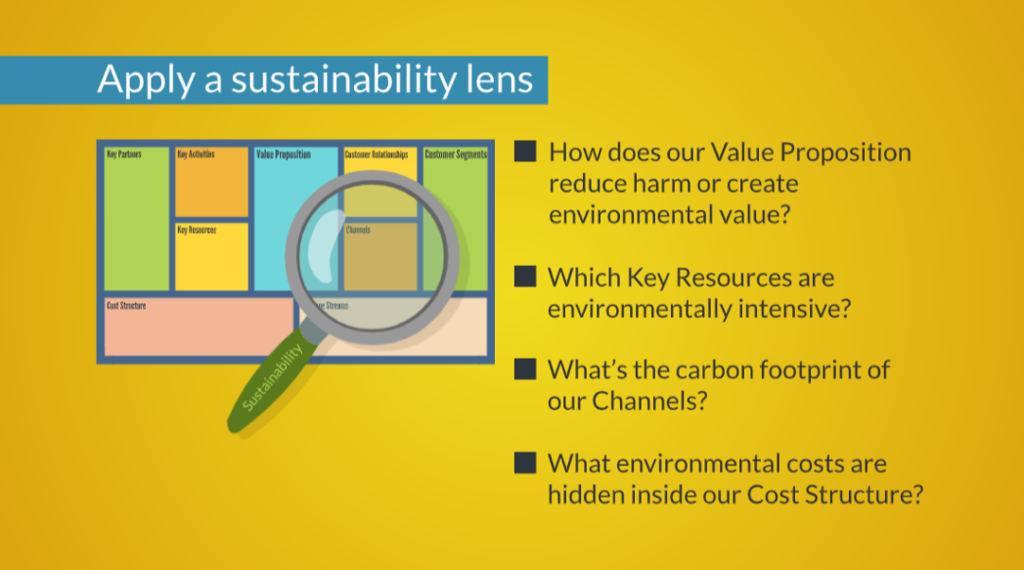
Apply a sustainability lens to all nine existing blocks instead of adding new ones. Ask:
- How does our Value Proposition reduce environmental harm?
- Which Key Resources are environmentally intensive?
- What’s the carbon footprint of our Channels?
- What environmental costs hide in our Cost Structure?
This keeps the Business Model Canvas intact while deepening strategic thinking. Sustainability becomes a mindset, not a bolt-on.
The verdict on modifying the Business Model Canvas
Adding eco-social blocks works as a teaching tool or workshop focus, but if you need extra boxes because sustainability isn’t appearing in your original nine blocks, you’re not applying the canvas deeply enough.
The real power of the Business Model Canvas comes from using it as designed – with elevated, integrated thinking about every aspect of your business model, including sustainability.